Can't wait for Nov. 23? Here's a look at what you can get today!
Like winter in Game of Thrones, Black Friday is coming. In fact, it's just over a week away: Nov. 23. Of course, it's now tradition that nearly every store has announced its Black Friday sales -- and many of them have already started them.
Below you'll find a list of some of the best deals you can get right now. They may be short-lived, but anything that sells out or expires is likely to return in the days and weeks to come. (Also, take note: I'm vetting these deals to make sure they're not just everyday sale prices that are being marketed as "early Black Friday deals.")
Be sure to bookmark this page, as we'll be updating and adding to the list as more deals emerge!
Originally published Nov. 1.
Update, Nov. 15:
 New deals have been added to the post and expired deals removed.

Fire TV Stick and Echo Dot (second-gen): $40 (save $40)

Sarah Tew/CNET
For less than the regular price of an Echo Dot alone, you nab both the smart speaker and Amazon's Alexa-imbued streaming stick.

Polk Audio Command Bar with Alexa: $199 (save $100)

Sarah Tew/CNET
This voice-powered sound bar features a wireless subwoofer and a dialogue-enhancing Voice Adjust option. This is an honest-to-goodness early Black Friday deal -- the Command Bar has never been priced lower. 

Appliances at Home Depot: Save up to 40 percent

Home Depot
If you've been holding off on a big-appliance purchase, this might be the time to buy. The Depot has discounts on a variety of refrigerators, washers, dryers and more, and you get extra savings with multiple appliance purchases. (Buy three items, for example, and you'll instantly get $150 off.)

Appliances at Lowe's: Save up to 40 percent

Lowe's
Not to be outdone, Lowe's is also cutting prices ahead of Black Friday. And like Home Depot, the store is offering extra savings on multiple appliances. The difference here is that those savings come in the form of a Lowe's gift card, not a cash discount.

TCL 55S405 55-inch Roku TV: $350 (save $100)

This 2017 model (aka Series 4) remains CNET's favorite budget 4K TV -- and that recommendation was based on the higher price tag. Although there are models with slightly better pictures, with this baby, it's all about the interface.

Refurbished Apple AirPods: $120 (save $40)

Óscar Gutiérrez/CNET
We haven't seen many exciting AirPod deals for Black Friday proper, but if you don't mind going the refurb route, these Geek Squad-recertifieds will save you a pretty decent penny.

Red Dead Redemption 2 (Xbox One) + $10 Xbox gift card: $60

This super hot new game has been discounted a few times leading up to Black Friday, but as of right now, this is the best deal going.

HP Pavilion x360 15.6-inch convertible laptop: $529 (save $170)

HP
Only the somewhat low-resolution display (1,366x768 pixels) mars this otherwise powerful portable, which features a Core i5 processor, 8GB of RAM, a 1TB hard drive and an HP Digital Pen for onscreen art, note-taking and so on.

Save an extra 10 percent on refurbished tech at Decluttr

Decluttr
Before you spend big bucks on a new phone, consider spending smaller bucks on a refurbished one. The gear-recyclers at Decluttr are offering an extra 10 percent off all refurbished tech when you apply promo code TECH10 at checkout.
More to come!
Read more: How to tell if that Black Friday deal is really a deal

Coming soon

Amazon's devices all have sale prices: Starting Nov. 16, Amazon gear will see some hefty discounts. Some best bets include the Fire HD 10 tablet for $100, the Fire TV Cube for $60 and the second-gen Echo for $69.
An Xbox One or PS4 at Target for $200: You'll have to brave the stores to get one, but Target is really hoping to get you into a next-gen game console. Which you should totally do, given the arrival of hot new games like Red Dead Redemption 2 and Spider-Man.
A Fitbit Versa for $150, also at Target: Priced just about $200 everywhere else, the Versa is arguably the best Apple Watch alternative you can buy. Will other stores match this all-time-low price? Time will tell. For now, Target has the deal to beat.
The Huawei Honor View 10 phone for $349 at Amazon. Normally $500 (and currently $479), the powerhouse metal phone, will drop to an all-time low starting Nov. 23. Read CNET's View 10 review to see if it's destined to be your next pocket-pal.
And here are some Black Friday deals we're assembling by category:
  • Black Friday TV deals 2018: The best and the cheapest
That's it for now! But there's a lot more to come, so check back soon.

Black Friday 2018: The best deals on sale right now

Facebook's Zuckerberg pushes back at criticism over handling of scandals

A 5G OnePlus phone for Verizon? Don't hold your breath

But China has more of the 500 fastest machines on the planet than ever, and the US hits an all-time low.

IBM built Lawrence Livermore National Laboratory's Sierra supercomputer.
Randy Wong/LLNL
The US now can claim the top two machines on a list of the 500 fastest supercomputers, as Sierra, an IBM machine for nuclear weapons research at Lawrence Livermore National Laboratory, edged out a Chinese system that last year was the very fastest.
The Top500 list ranks supercomputers based on how quickly they perform a mathematical calculation test called Linpack. The top machine, IBM's Summit at Oak Ridge National Laboratory, had claimed the No. 1 spot in June with a speed of 122.3 quintillion mathematical operations per second, or 122.3 petaflops.
But an upgrade gave it a score of 143.5 petaflops on the newest list. To match that speed, each person on the planet would have to perform 19 million calculations per second. Sierra got an upgrade, too, boosting its performance from 71.6 petaflops to 94.6 petaflops and lifting it from third place to second.
Summit and Sierra are siblings, each using IBM Power9 processors boosted by Nvidia Tesla V100 accelerator chips and connected with Mellanox high-speed Infiniband network connections. They're gargantuan machines made of row after row of refrigerator-size computing cabinets. Summit has 2.4 million processor cores and Sierra has 1.6 million.
Supercomputers are used for tasks like virtual testing of nuclear weapons, aerodynamic modeling of aircraft, understanding the formation of the universe, researching cancer and forecasting climate change effects. They're expensive but prestigious machines that can keep scientists and engineers at the vanguard of research.
Supercomputers have gotten steadily faster on the Top500 list of the world's fastest machines, but those gains started faltering about a decade ago as chip performance slowed down.
Top500
The US once dominated the Top500 list, but China has steadily risen in clout. Its Sunway TaihuLight topped the Top500 for two years with a 93 petaflop score, and China extended its lead in the number of machines on the list.
A total of 227 of the Top500 machines are in China, compared with an all-time low of 109 for the US. The November list is the 52nd one released by a collection of academic researchers who compile it twice yearly for supercomputing conferences.
Linpack is only one speed test, though, and the Top500 has another designed to capture a broader range of performance abilities, the High-Performance Conjugate Gradient (HPCG) benchmark. On it, Summit and Sierra are head and shoulders above competing supercomputers.
Although Summit and Sierra use IBM's Power9 CPUs, the vast majority of Top500 machines use Intel processors. With the difficulties maintaining the performance increases described by Moore's Law, supercomputer makers have increasingly turned to various accelerator chips more specialized for mathematical calculations. Nvidia's chips, derived from its graphics processors, dominate this usage.

Upgraded US supercomputers claim top two spots on Top500 list

China's state news agency has unveiled a virtual newsreader sporting a sharp suit and a somewhat robotic voice.
Xinhua News claims the presenter "can read texts as naturally as a professional news anchor", though not everyone may agree.
"Hello, you are watching English news programme," says the English-speaking presenter at the start of his first report.
Sogou, a Chinese search engine, was involved in the system's development.
"I will work tirelessly to keep you informed as texts will be typed into my system uninterrupted," says the presenter in an introductory video.
"I look forward to bringing you the brand new news experiences."
There is also a Chinese-speaking version with a different face.
Xinhua says the presenters can "work" 24 hours a day on its website and social media channels, "reducing news production costs".
The agency points out that they may be particularly useful for disseminating breaking news reports in a timely manner.
An artificial intelligence (AI) system has been used to synthesise the presenters' voices, lip movements and expressions. They are based on those of real Xinhua presenters.
This is different from using a 3D digital model of a human. It appears that photo-like facial features have been applied to a body template and animated.

'Uncanny valley'

The presenter struggled to appear completely natural, said Michael Wooldridge at the University of Oxford.
It was stuck somewhat in the "uncanny valley" - a term used to describe human-like robots and avatars which seem subtly unrealistic.
"It's quite difficult to watch for more than a few minutes. It's very flat, very single-paced, it's not got rhythm, pace or emphasis," Prof Wooldridge told the BBC.
He also pointed out that human news presenters have traditionally - in many cases - become highly trusted public figures.
"If you're just looking at animation you've completely lost that connection to an anchor," he added.
It was a "good first effort", however, said Noel Sharkey, emeritus professor of artificial intelligence and robotics at the University of Sheffield.
"We will see it improve over time," he told the BBC. "The problem is that it could be very dull."

China's Xinhua agency unveils AI news presenter

Xiaomi - the world's fourth bestselling handset maker - has added the UK to is growing list of markets.
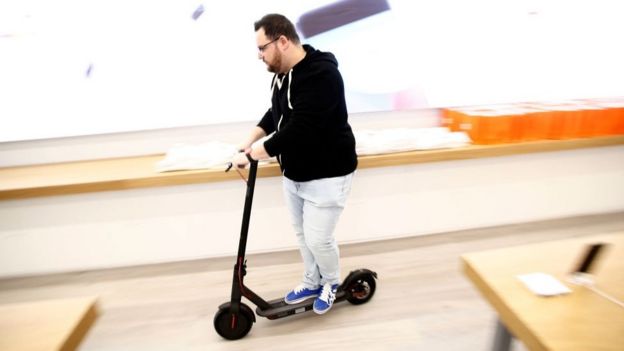
The Chinese firm's initial line-up for the country includes three smartphones, a fitness-tracking wristband and an electric scooter.
It is also opening a shop in London's Westfield Shepherd's Bush shopping centre, which also has an Apple store.
The launch expands its presence in Western Europe, where it is also active in Spain, France and Italy.
Xiaomi has a reputation for competitively pricing its products and seeking to maximise earnings by prioritising volume over profit mark-up.
XiaomiImage copyrightGETTY IMAGES
Image captionXiaomi's electric scooter will go on sale in the UK, despite the fact it cannot be legally used along roads or in other public spaces
Earlier this year, it announced it would limit its hardware products' net profit margin to 5%, suggesting the move would help convince customers it was a brand that could be trusted.
According to market research firm IDC, only Huawei's smartphone sales are outpacing it in terms of growth among the major manufacturers.
CompanyJuly-September smartphone shipmentsYear-on-year change in shipmentsCurrent market share
Samsung72.2 million-13.4%20.3%
Huawei52.0 million32.9%14.6%
Apple49.9 million0.5%13.2%
Xiaomi34.3 million21.2%9.7%
Oppo29.9 million-2.1%8.4%
Others119.9 million-19.9%33.8%
Total355.2 million-6.0%100.0%
Source: IDC - based on preliminary data
Xiaomi's initial flagship phone for the UK will be the Mi 8 Pro - an Android handset with a fingerprint sensor hidden behind its 6.2in (15.7cm) display, and a transparent glass rear through which some of its components can be seen.
It will start at £499. That is is significantly less than the cost of premium models sold in the country by Apple, Samsung, HTC, Sony and Huawei, but it matches the price of OnePlus's new 6T.
  • Samsung reveals folding smartphone
  • Xiaomi phone threatens a price war
  • Huawei's Watch has no time for Android Wear
Co-founder Xiang Wang told the BBC that Xiaomi intended to expand its range of products in the UK in 2019, and might also launch its sub-brand Poco.
And while he said his firm has no plans at present to hold one of its famous "flash sales" in the country - in which limited quantities of a new device are put on sale at a set time - he indicated that they could be offered at a later date to help drive awareness.
Xiaomi shop in BeijingImage copyrightGETTY IMAGES
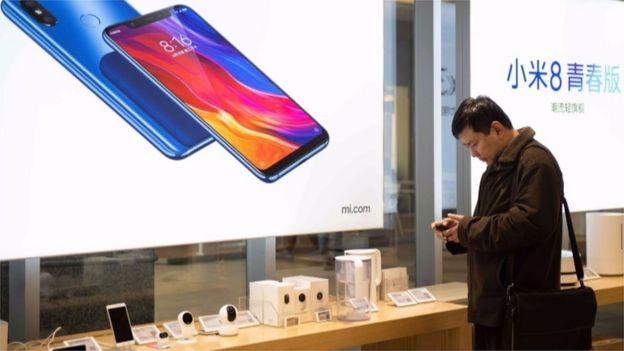
Image captionXiaomi operates more than 100 stores in China and aims to have 1,000 by 2020
"When Xiaomi enters a country they almost always grow very fast," commented Neil Mawston, from the consultancy Strategy Analytics.
"That's happened in India, Indonesia and Russia and now we're seeing it grow very quickly in Spain.
"Those most at risk of losing sales to them in the UK include Samsung, Huawei, TCL Alcatel, LG and ZTE - Apple is probably safe because it plays in much higher price tiers."
Another expert added that it would be a mistake solely to focus on the company's smartphone ambitions.
"It's jaw-dropping the amount of products that Xiaomi makes," said Ben Wood, from the CCS Insight consultancy.
"When you go to one of its stores in Hong Kong it's incredible - there's everything from robot vacuum cleaners to smart lamps to air purifiers to electric toothbrushes.
"But the big question for me is whether this is a market too far given that there is already an unprecedented level of competitive intensity here, particularly among smartphones."
Xiaomi launchImage copyrightCCS INSIGHT
Image captionXiaomi's UK launch marks its entry into a fourth Western European market
However, a third analyst said the Chinese company may have picked the perfect time to join the fray.
"After the UK leaves the European Union, we may see consumers rein back on discretionary spending, resulting in a falling average sales price moving forward," said James Smith, from Futuresource Consulting.
"Should the consumer wallet be squeezed... we may see increasing demand for mid-range handsets, a market in which Xiaomi has a very strong offering."

China's Xiaomi enters UK with phones, wristband and scooter